















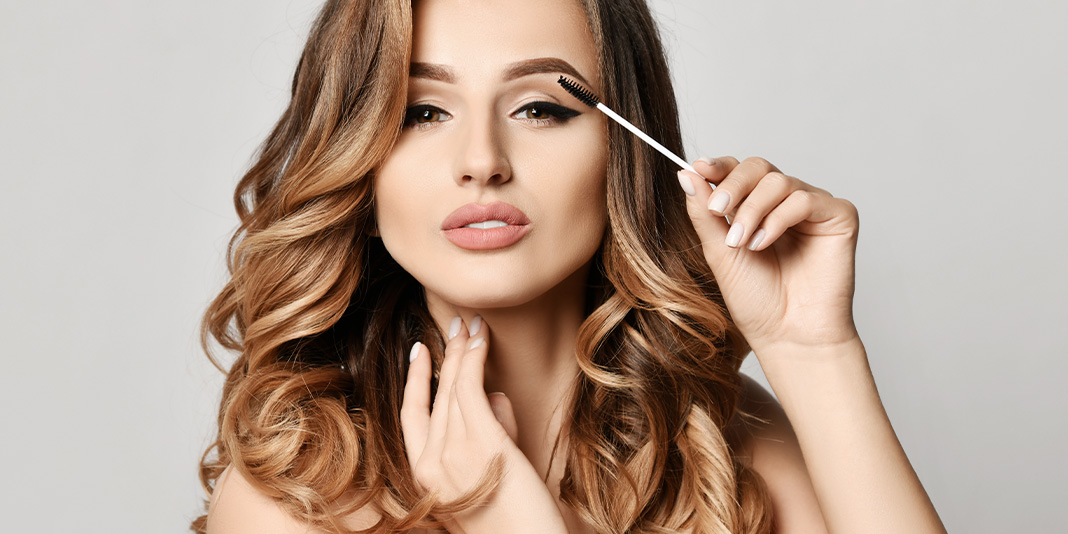







Women and makeup have a complicated relationship.
Some revel in it, running from CVS to Sephora to try on every last trend, delighting in transforming their look with the flick of a brush. Others keep it simple, sticking with the bare basics and often forgetting to put it on at all. And many abhor the stuff, either because they don’t like its feel on their skin, or don’t like what it stands for.
Love it or hate it, women have been using makeup, in different forms, for a very long time.
Fashionable sixth century women made their faces paler by bleeding themselves, either directly or with the help of leeches. During the Italian Renaissance, women coated their faces with toxic chemicals including arsenic, lead and mercury.
It was even popular to look sickly in the 19th century, when tuberculosis was considered a “romantic” disease. Women of that era emphasized the circles under their eyes and used rouge to look flushed with fever.
When did people first start using makeup? No one is 100 percent sure. The first archeological records of clear makeup use come from Ancient Egyptian and Sumerian tombs dating as far back as around 3500 BC. They used soot and other natural ingredients to paint their faces, and even had specialized tools to apply their makeup.However, paints and other means of self-decoration date back tens of thousands of years. Archaeological sites in South Africa provide evidence that body paint may have been used over 50,000 years ago, suggesting people painted their bodies before they even wore clothes. Even our closest relatives, the Neanderthals, may have worn makeup and jewelry.But the real question is, why? Not why do we wear it—anyone who has ever felt gorgeous after a swipe of rosy blush can tell you that makeup can help us feel, and thereby look, pretty—but rather, why does it work?
In the animal kingdom, females advertise sexual availability and quality through physical signals. Whether it’s red rumps or elaborate behaviors, these wild women make it well known to potential mates that they’re interested in, ready for and capable of producing healthy babies. We humans lack these flagrant signals—it’s almost impossible to tell if a woman is fertile. Almost.
If you look at makeup use across cultures and eras, a pattern emerges. In theory, one could put color anywhere on the face. But all cultures have independently agreed on certain beauty principles: Makeup is used to even the complexion, darken the eyes, pinken the cheeks and redden the lips, no matter if you’re a doll-like Japanese Geisha, an Ancient Egyptian or a modern American woman primping for a Saturday night out. “The maintenance of youthful features and the exaggeration of female typical traits can be found in almost every culture,” says Dr. Bernhard Fink, a professor at the University of Göttingen who studies the evolutionary psychology of human mate preferences. Makeup works because it exaggerates (or completely fabricates) our natural signs of youth, fertility and sexual availability, thus making a woman seem more appealing. In other words, it works because it’s a darn good lie.
MORE: What Makes a Face Beautiful?
Studies have shown that women’s faces are more attractive to both sexes near ovulation, when they’re most fertile. During this time, the relative concentration of the hormone estrogen rises in comparison to progesterone. This hormonal shift enhances vascular blood flow under the skin’s surface, which has a few side effects: Women near ovulation report that they’re more easily turned on and have more interest in sex. But this increase in blood flow also leads to visible signals—pinker cheeks and redder lips. Thus by putting on reddening lipstick, we accentuate a natural signal of fertility.
On top of that, blood flow also increases during arousal, so those red lips and pink cheeks are not only implying that her body is ready to have a baby, they’re also saying that she’s interested in having that baby with you, the man she’s talking to right now, which of course is bound to draw attention from potential suitors.Eye makeup and lipstick work synergistically to make a face appear more feminine. “Women tend to be naturally darker around their eyes and mouths than men of the same skin tone. When women use cosmetics to darken the eyes and lips, they are exaggerating this sex difference to make the face appear more feminine,” explains Dr. Richard Russell, an Assistant Professor of Psychology at Gettysburg College.
 |
The key, Russell has found, is contrast. The darker the facial features in relation to the skin tone, the more feminine a face appears. His research has shown that this phenomenon is so important in distinguishing gender that the exact same face can be perceived as either male or female depending on the level of contrast.
In Russell’s study, two near-identical faces were made by blending male and female faces. The only difference between the two was that one face had a lighter skin tone, thus creating more contrast. Most subjects thought the face with less contrast was male and the one with more contrast was female even though they had the exact same eyes, nose and mouth! Russell also found that when you digitally darken the eyes or the lips of a woman’s face, it becomes more attractive, while the opposite is true for a man’s. It’s not just bold colors that matter. Foundation and cover-up also play a large role in making a woman look more attractive because even skintones give the impression of youth. “Both skin topography and skin coloration affect the perception of facial age, health and attractiveness,” says Fink. “Skin topography seems to be a strong age cue while skin coloration is a stronger predictor of facial health perception.” When we’re young and healthy, our skin is flawless. But as we get older, our skin tends to get discolorations and become less even-textured, whether from the sun, scars or other kinds of damage. It’s not surprising that covering up such imperfections makes us appear younger and healthier.
RELATED RESEARCH: Even Skin Looks Healthy, Youthful
But, you’ll often hear women say, MY (boyfriend/husband/partner/whoever) says that I look prettier without makeup! Well, it’s true that when you poll men about their makeup preferences, as many as one in five says their significant other wears way too much makeup, while one in ten wishes that women didn’t wear makeup at all. There is no doubt that a good portion of men will gladly say women look prettier without it.While that’s certainly a nice sentiment, their actions speak louder than their words. Study after study has found that when shown pictures of women with and without makeup, men (and women!) consistently rate images with makeup as more attractive, confident, feminine and healthy.
Makeup doesn’t just change how men view a woman’s looks. When asked about personality measures, men also give higher scores to women who wear makeup. Waitresses wearing makeup also earn higher tips from their male clientele. Studies have found that guys think those makeup-wearing gals have more prestigious jobs and are more intelligent, secure, interesting and organized!
We’re not saying wearing makeup is more likely to get you hit on at a bar, but Dr. Nicolas Guéguen, from Université de Bretagne-Sud, is. He found that men approached a woman sooner and more often when she wore makeup than when she didn’t. Guéguen thinks that makeup may not be just about looking prettier, though. “Perhaps the effect of makeup is not to enhance physical attractiveness per se,” he writes, “but to serve as a cue to males that ‘this female might be available.”Whatever makeup says, it works, and not just on the men. Women feel prettier when they’re wearing makeup. A study of American college students found women had higher opinions of their own bodies and appearance when made up. Putting on cosmetics has been shown to boost self-image in a variety of different women, from the elderly to surgery patients.It’s no wonder that we shell out around $40 billion dollars a year on this stuff. We are drawn to makeup because it taps into our primal urge to enhance our femininity, distinguish ourselves from men and prove that we are a catch—whether we realize that’s what we’re doing or not.