



































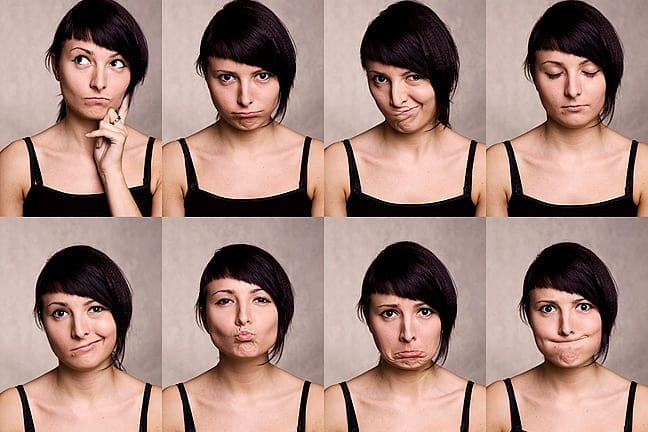
You may think of a smile as the universal signal of happiness, but a new study finds that the way different countries around the world perceive facial expressions isn’t so black and white.In the study, 15 people of Chinese descent and 15 Caucasians living in Glasgow, London, were shown computer-generated faces that were altered to suggest expression. Participants were asked to label each face as happy, sad, surprised, fearful, disgusted or angry.
Surprisingly, the answers varied. While Chinese participants looked to the eyes to decipher expression, Western Caucasians focused on the eyebrows and mouth. Difference in interpretation was seen throughout the facial expressions, but the perception of fear and disgust especially differed between the two groups.
QUIZ: How Satisfied Are You With Your Face?
“We conducted this study to objectively examine cultural differences in facial expression signals, as a previous study of ours [Jack et al., 2009] showed that East Asian groups do not recognize facial expressions widely considered to be universal,” says lead researcher Rachael E. Jack, PhD, of the Institute of Neuroscience and Psychology at the University of Glasgow, UK.
Understanding how cultural groups perceive expressions differently could lead to more effective communication in an increasingly globalized world, adds Jack.
The findings fly in the face of the seminal thesis on the topic—Darwin’s “The Expression of the Emotions in Man and Animals” (1898)— which argues that facial expressions are hard-wired as an evolutionary trait that is recognized by all species, regardless of culture or origin.
 |
Other research in recent times heralds more evidence that facial expression recognition is a learned skill, and not instinctual.
In another study that also had participants label a face as happy, angry or sad, researchers instead surveyed about 80 Japanese and American students, and included four people in the background of the picture.
Whereas 70 percent of the East Asians said their answer was influenced by the expressions of faces in the background crowd, approximately the same percentage of Westerners said they didn’t consider the group in their decision about the individual—a pattern that the head researcher conjectured could be connected to the Western emphasis of the individual, and the Eastern focus on the whole society as one.
COLUMN: The Power of Smiles by Art Markman, Ph.D.
“People raised in the North American tradition often find it easy to isolate a person from [their] surroundings,” says study lead Takahiko Masuda, a psychology professor at the University of Alberta. “East Asians seem to have a more holistic pattern of attention, perceiving people in terms of the relationships to others.”
The Japanese even have a common phrase for this type of perception: “kuuki wo yomu,” which translates into “reading the air.” In other words, you need to gauge how the full environment is influencing a particular situation before you draw a conclusion.
The perceived difference in facial expressions has even tapped into the wireless age, with another study led by Masuda that reveals emoticans used in emails, texting and chat also differ between Eastern and Western countries.Japanese emoticans were found to convey happiness and sadness with the choice of characters for eyes, while Americans changed the direction of the mouth. For example, (^_^) and (;_;) indicate happiness and sadness for the Japanese, while 🙂 and 🙁 were used for the same emotions by Americans.
MORE: When Body Language Backfires
“We think it is quite interesting…that a culture that tends to mask its emotions, such as in Japan, would focus on a person’s eyes when determining emotion,” observes Masuda. “In the United States, where overt emotion is quite common, it makes sense to focus on the mouth, which is the most expressive feature on a person’s face.”