




















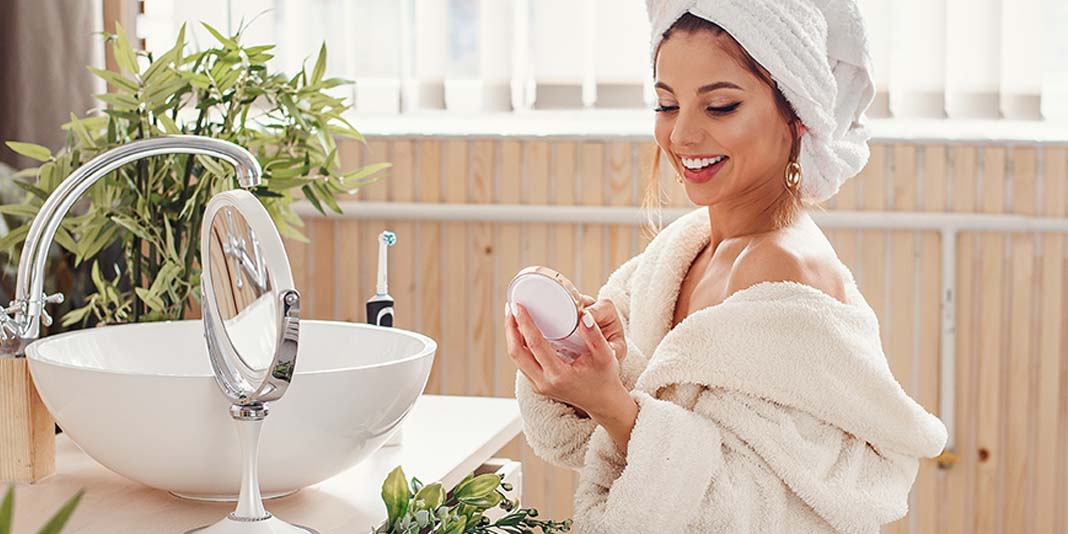
Take a moment and mentally replay your daily personal care routine: soap, shampoo, conditioner, body lotion, deodorant, foundation, mascara.The list goes on and on.That’s normal. If you’re an average American woman, you use at least a dozen different products every day without blinking. But we’re becoming increasingly aware that certain ingredients in these products could harm our health and beauty.This awareness is reflected on store shelves. Beauty product labels used to advertise what they contained, but many now tout what they don’t. A quick glance down the cosmetics aisle and your brain will register terms like BPA-, phthalate- and paraben- free. But what to these chemicals actually mean to our health and beauty?In the US, over 10,000 industrial chemicals are used as ingredients in personal care products. Most occur in low levels that are considered safe—but they aren’t tested for safety with long-term use before they hit stores. The F.D.A.’s Office of Cosmetics and Colors flat-out states that “a cosmetic manufacturer may use almost any raw material as a cosmetic ingredient and market the product without an approval from the F.D.A.”MORE: Are You Using Toxic Cosmetics?Most of the worry is placed on ingredients that act as endocrine disruptors.Your endocrine system is a system of glands that regulates biological processes like growth and development, metabolism, tissue function and mood. It secretes hormones into the bloodstream, which act as messengers, telling different parts of the body what to do. An endocrine disruptor is a synthetic chemical that does what its name implies—it messes with your body’s natural signals.These hormone doppelgängers have the potential for a wide variety of side effects, ranging from milder issues like acne and weight gain to potentially serious conditions like birth defects and cancer. Since beauty products are directly applied to the skin, harmful compounds enter the bloodstream directly, bypassing the protective mechanisms in the gut and liver. Even more importantly, toxins can accumulate in our bodies because we don’t get rid of them as fast as we are exposed, a process called bioaccumulation. So even low doses, if frequent and sustained, can lead to dangerous concentrations within us.Bisphenol A, or BPA, is the most talked about endocrine disruptor of concern. Although its hormone-mimicking activity has been known for decades, it’s still commonly used in the making of cosmetics and their plastic containers.COLUMN: BPA: The Unfriendly, Everyday Chemical, by Dr. Oz & Dr. RoizenMultiple studies have linked BPA exposure to detrimental developmental effects. The evidence was strong enough for several countries—including Canada, Denmark and China—to ban or limit the use of BPA in baby bottles and other child-targeted products. Pregnant women, too, are recommended to avoid BPA. As the authors of a recent review study wrote, when it comes to exposure in the womb, “we don’t know what a safe level of BPA is.”BPA isn’t the only ingredient under siege when it comes to children’s health. Chemicals called phthalates are also highly scrutinized. Exposure to phthalates, which are found in everything from PVC pipes to perfumes to nail polish, has been linked to medical problems in infants and children including allergies, asthma and ADHD. The growing body of evidence against phthalates prompted the European Union, Canada and the US to ban the use of them in children’s toys.However, these bans may not be cutting exposure as dramatically as lawmakers hoped, because studies suggest infants are exposed to phthalates though their use in baby care products. Scientists found strong positive correlations between urine phthalate concentrations and the use of infant lotions, powders and shampoos.MORE: Can Shampoo Make You Fat?The mother’s personal care regime may be to blame as well. The more personal care products a woman uses, the higher her phthalate levels, and increased levels in pregnant women are linked to low birth weight and developmental issues.Although the heart of the debate has focused on how dangerous endocrine disruptors are to children and infants, the case for their dangers to grown-ups has been building. Since these ingredients can act like estrogen in the body, they have the potential to have serious side effects, even in adults.Hormones don’t just control development; they’re also tied to our weight, muscle building ability, skin condition and immune system. It’s no wonder that endocrine disrupters have been linked to adult health conditions. Phthalates are associated with lower testosterone levels, increased waist circumference and type II diabetes in men, while bisphenol A is associated with cardiovascular disease and weight gain in both women and men.Hormone-mimics are also blamed for the onset or exacerbation of a number of cancers, especially breast cancer. Many of the endocrine disruptors in personal care products, including BPA, phthalates and another group of anti-microbial agents called parabens, have been found in breast cancer tissues, and lab research has supported the hypothesis that exposure to them may contribute to breast cancer risk. Similarly, endocrine disruptors are suspected as possible risk factors for neurodegenerative disorders, including cognitive decline, memory loss and Parkinson’s disease.But that’s not to say that all of these ingredients should be seen as serious threats.“One of the issues about phthalates that people don’t necessarily understand is they are a family of chemicals,” explains Dr. Susan Teitelbaum, an associate professor from The Mount Sinai Medical Center. “Different phthalates have been shown to have different biological activities.” Some phthalates appear to have no adverse affects, and in a recent study of Mexican women, some were even associated with reduced breast cancer risk. By broadly grouping all of these compounds together, we may demonize those that are less harmful. Furthermore, some have weighed the evidence and believe there’s no reason to worry. In an exhaustive review, Drs. Raphael Witorsch and John Thomas concluded, “although select constituents [of personal care products] exhibit interactions with the endocrine system in the laboratory, the evidence linking personal care products to endocrine disruptive effects in humans is for the most part lacking.” They cite contradicting animal studies, weak connections between human exposure and toxic effects, and point out flaws in studies on people, all of which leave room for doubt.So what does this all mean?“There is no harm if people choose to pick products that are phthalate free,” says Dr. Teitelbaum. The same goes for BPA, parabens, and any other chemicals of concern.QUIZ: How Healthy Do You Feel? Since these chemicals aren’t safety tested in advance, we simply don’t know yet what problems they might cause.What we do know is that many beauty companies have found ways around using these potentially harmful compounds in their products, and limiting exposure of the main offenders to infants, children and pregnant women can only be a good thing
LATEST