


































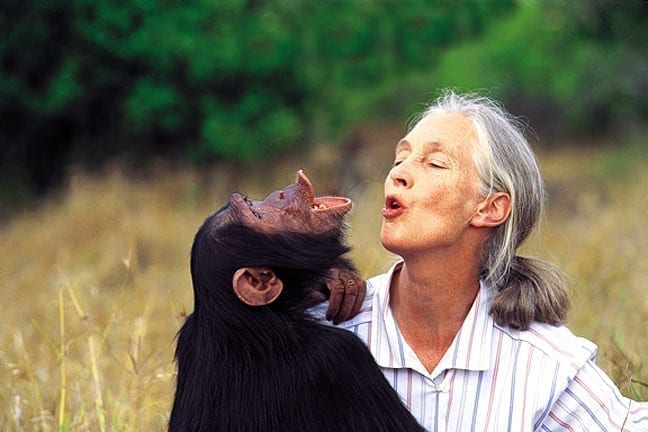
When you think of chimpanzees, it’s nearly impossible to not think of Jane Goodall.The famed primate researcher—whose social contributions often draw peace-bearing comparisons to names like Gandhi, Mother Theresa and Nelson Mandela—is the embodiment of inner and outer beauty. Goodall was 29, when, in 1960, she began living alone in the jungle with chimps. With no formal scientific education, she made discoveries that forever changed the relationship between humans and animals.Now 77 years of age and maintaining a strenuous schedule that includes 300 days of travel a year, Goodall still delights at the opportunity to share expertise on her life’s passion—chimps. We asked the British native—who is busy preparing for Jane Goodall Live, a one-night-only event in movie theaters nationwide on September 27th (more on that at end of the article)—what, we as humans, can learn from our ape “cousins.”Goodall says it is the emotional and relationship connections between chimps that we stand to learn the most from, and that the science community’s evolving mindset on that dynamic has come nearly full circle during her decades of study.“When I first started studying chimpanzees in 1960, it wasn’t appropriate to talk about chimps having personalities. I was told I shouldn’t give them names, I should give them numbers,” remembers Goodall, of the customary labeling practice of the time. “That has softened considerably. There has been a change in our understanding of chimps.”MORE: Animals Offer CompanionshipGoodall cites the childhood experience of growing up with a family pet named Rusty as the reason she persisted in observing relationships and personalities in chimps, in spite of academia’s consensus at the time that no such thing existed. “Well, I thought, ‘Of course animals have feelings,’” reflects Goodall. “Anyone with a family dog knows that.”One important lesson to be learned from chimps: Don’t go to bed angry at your partner.“With chimpanzees, it’s very important to them that tensions are resolved,” explains Goodall. “The chimp who has been the victim of an aggressive incident is likely to approach the aggressor, crouching, frightened, and nervous, and sometimes even with his back facing forward, ready to run at any moment. But he will nevertheless extend his shaking hand,” continues Goodall. “The dominant will reach out to it, and sometimes even embrace the chimp. And you can immediately see the tension relax and harmony is restored to the group.”MORE: 5 Tips for Healthier, Happier Conversations “It’s quite funny,” continues Goodall. “It reminded me of my grandmother, who used to always quote this verse from the bible, ‘Let not the sun sink on your anger.’ She would always make us say sorry to one another before we could go to bed. It’s the same concept.”Another compelling relationship patterns she observed in chimps was that handling during infancy seemed to directly shape the chimp’s personality and behaviors as it grew older. Chimps, as it turned out, did not just feed and protect babies; adults were often observed to be just as much as the careful parent as a human, taking care to comfort, educate and encourage their young.COLUMN: Attachment Styles of Parenting“I learned the impact was tremendous,” says Goodall. “Human psychologists emphasize this is also true for human infants today, but it’s easier to trace the behavioral connection with a primate. It’s direct,” she says. For example, an upbringing marked by violence very often begets a violent adult temperament in chimps.On the other hand, studying the same phenomenon in humans proves more challenging. Humans can express emotional trauma in a multitude of unpredictable ways, which can grow further complicated if they try to conceal or suppress behavior they find shameful, says Goodall.Attachment parenting—today, a popular concept that theorizes the emotional connection formed between child and caregiver during infancy and developmental years will shape and determine adult persona—deduces the same framework that Goodall observed in chimps.The success of Goodall’s in-depth studies are attributed to her ability to sit and observe amongst the chimps, once even becoming a live-in member of a troop for nearly two years—an assimilation feat that has never been repeated.And surprisingly, it was her gender that Goodall partly attributes to her ability to embed so deeply among the chimps, in order to learn their behaviors first-hand.“Being a woman was very helpful in the early days,” says Goodall. “Tanzania had newly acquired independence, and they were often not very well at ease with white male researchers, since white males had ruled for so long over the colonies,” says Goodall, of the country where the depth and breadth of her work took place. “They didn’t perceive me as a threat, since I was a woman. It gave me access.”QUIZ: What’s Your Attachment Style?Goodall will appear in Jane Goodall Live, a one day only broadcast at movie theaters across the country on Tuesday, September 27th at 8/7pm EST/CST, with a tape delay for the west coast at 8p.m. PST.
 |
In addition to a live Q &A session hosted by Charlize Theron, the cinematic biography, “Jane’s Journey” will be shown, which follows the footsteps of Goodall’s maiden voyage to Africa at the age of 26 to study chimpanzees in the depths of the jungles of the Gombe Stream Reserve in Tanganyika, and all the way through a lifetime of legendary discoveries surrounding what she believes is the predecessor species to humans.Unseen 8mm film found in the attic of Goodall’s U.K. home will make its debut in addition to other rare first-hand footage, as will appearances by famous friends and fellow activists Angelina Jolie, Pierce Brosnan and Dave Matthews. Ticket cost varies by city, but will average $15 per seat for the two hour and 15 minute show. To find a theater near you, check the website Jane Goodall On the Big Screen.