



































The bills. The job. The kids. Whether you’re worrying about finances or fretting over your family, it’s easy to let a wandering mind keep you from getting the sleep you crave. “The mind plays a powerful role in how we sleep,” says Michelle Drerup, PsyD, a behavioral sleep medicine specialist at the Cleveland Clinic. “A lot of times, it can be worry specific to sleep itself, and we start dreading going to bed. But there are also general worries about life, like work worries or an ill parent.”
A restless mind can keep you from being as relaxed as you need to be to ease into a good night’s sleep. The key is taming your thoughts.
Recipe for relaxation
Lie on your back (in bed or near a wall) with your hips close to the headboard or wall, and straighten your legs up against the wall. Rest your arms at your sides or on your belly. Close your eyes, relax and breathe. Remain like this for one to two minutes. Then hug your knees into your chest and rock from side to side a few times before getting up.
Make Time to Worry
According to the National Sleep Foundation’s 2009 poll, almost a third of Americans are sleeping poorly because of concerns about their finances and the economy. If you’re one of them, you might want to devote a half hour a night — an hour or two before you turn in — to the sleep-robbing task of worrying. That’s right, you can spend that time doing nothing but fretting, be it figuring out your finances, laying out what you have to do at your job the next day or pondering problems with your spouse. Write these concerns down on a list, and jot down possible solutions. “The idea is, ‘Okay, now I’ve already done my worrying, and I’ve got my plans ready,’” Drerup says. “For some people, this is really effective, especially if you’re the planning type of person.”
Say Namaste
Doing yoga does more than make you limber; studies show it may also induce sounder sleep. The deep abdominal breathing stimulates the vagus nerve, which runs from the base of the brain through the heart and stomach. “Inflating the abdomen on an inhalation and contracting it on an exhalation exerts pressure on this nerve, which in turn slows the heart rate and blood pressure and has a calming, soothing effect on the brain and the entire nervous system,” says Peggy Hall, a certified yoga instructor. Studies show that yoga also reduces cortisol, the stress hormone, while increasing levels of gamma-aminobutyric acid (GABA), a chemical messenger in the brain that signals you to relax and makes you sleepy.
Set the Stage
For some people, relaxation comes easily — simply plopping down on the couch can start the process. But for others, it actually takes some effort. To get things started, Drerup recommends doing no work, taking no phone calls and avoiding the computer in the hour before bed. “Everything you do in that hour should be relaxing, not stressful or strenuous,” she says. You might be better off taking a soothing bubble bath or reading a good book, activities that won’t rev you up.
Just Relax
Those of us who find it hard to unwind may benefit from relaxation exercises such as deep breathing, guided imagery or progressive muscle relaxation exercises. Whether you’re taking deep belly breaths, visualizing waves on an ocean or tensing and relaxing your muscles, the goal is the same: to ease you into a more relaxed state. “When we get stressed, the sympathetic nervous system goes into alert,” Drerup says. “That’s the fight- or-flight response. Relaxation activates the parasympathetic nervous system, which does just the opposite. That slows the heart rate and respiration, lowers blood pressure and prepares you for a better state of sleep.”
Get Zen
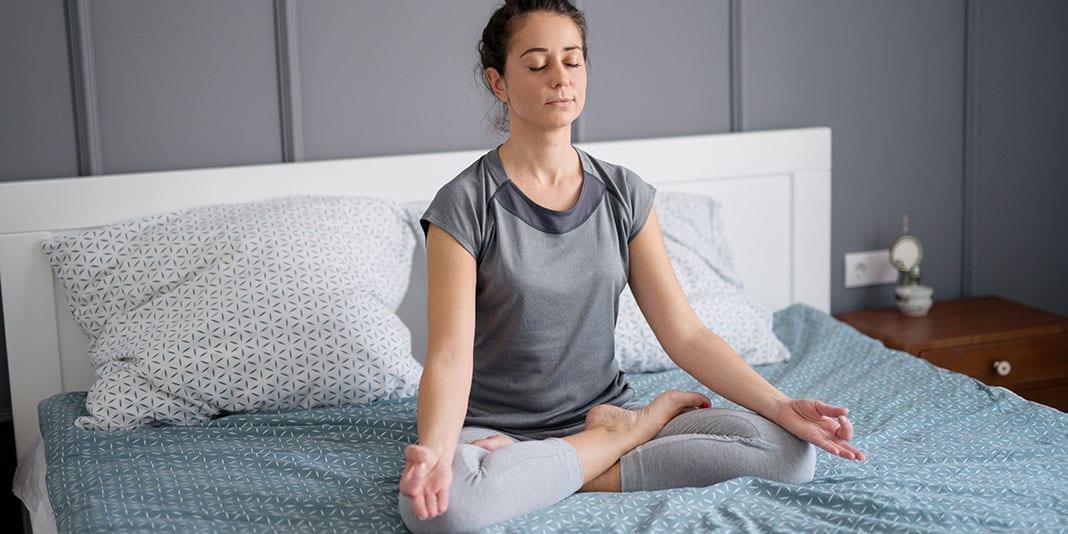
Learning to let go of troubling thoughts with meditation can soothe even the most agitated mind. To do that, consider mindfulness training. Mindfulness is a form of meditation that involves being aware of your thoughts but not reacting to them or judging them. Research by Jeff Greeson, PhD, a clinical health psychologist at Duke University, found that people who took an eight week course in mindfulness-based stress reduction reported better overall sleep afterwards and woke up less frequently during the night.With mindfulness, the goal isn’t to relax or even to suppress the thoughts. “The goal is to become more attentive and aware of whatever is happening at the time,” Dr. Greeson says. “You’re saying, ‘Okay, this is what I’m thinking.’”
To become more mindful, it’s helpful to redirect your thoughts to your breath by placing your hand on your belly and feeling it rise and fall as you breathe. “That helps pull the plug when we start feeling the pull of our thoughts,” Dr. Greeson says.— by Winnie YuMore from Cleveland Clinic/360-5.com
Best products for helping you sleep betterEating tips for better sleep