




























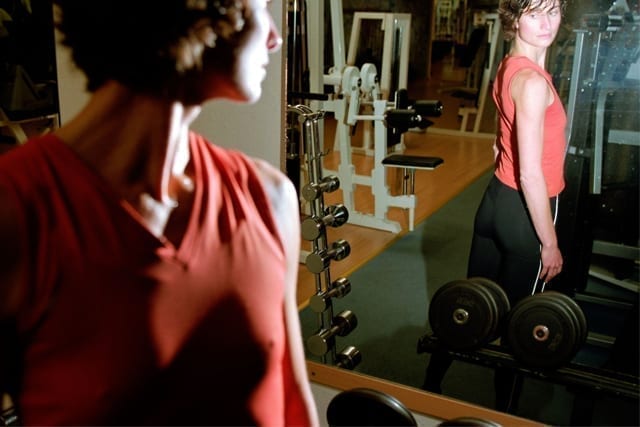
TV producer Jennifer Rumple was chatting with a friend recently. When the conversation went on longer than expected, she decided to grab a seat. As she zeroed-in on a chair with side arms, she balked. “‘I can’t fit my body into that,’” she thought. Then she remembered: In the past year, she’d shed 180 pounds and could easily fit in any chair she wanted.MORE: 10 Ways to Lose Fat—With Body ConfidenceWhen someone loses a significant amount of weight, his or her appearance is completely transformed. But oftentimes they still carry plenty of excess emotional baggage. Like Rumple, many “former fatties” have trouble squaring their newfound svelteness with reality.A Big Problem“When I was obese, I often felt as though people minimized me or overlooked me because of my weight,” notes Candy Gambichler, a medical office administrator who’s lost 50 pounds in the past 18 months. “There’s a definite difference in how people treat me now.”Gambichler finds that everyone from salesclerks to food servers are notably more cordial towards her since she’s slimmed down. It’s probably not her imagination either. As research shows, “obesity stigma” is a very real phenomenon.One extensive review by Yale University researchers in New Haven, Connecticut, found that 28 percent of teachers believe that becoming obese is the worst thing that can happen to someone, while 24 percent of nurses said that they are repulsed by someone who is obese. The Yale team also documented ways that weight bias translates into inequities across broad areas of life, from employment to health care to education. The researchers found that overweight people are pervasively stereotyped by others as lazy, unmotivated, lacking in self-discipline, less competent, noncompliant and sloppy. Ouch.MORE: Is Fat Stigma Skewing Your Weight Perception?But just because someone has lost the weight, doesn’t mean they suddenly forget the sort of hostility that was directed at them during all the years they were heavy. All of that negativity definitely takes a toll. Research suggests that feelings of depression, anxiety, poor self-image and being stigmatized persist long after the excess weight has vanished.Reactions from loved ones and co-workers can further complicate matters. Rumple says men who wouldn’t give her the time of day when she tipped the scales at over 350 pounds started coming out of the woodwork once she dropped the weight. While flattering, it also makes her a little bit angry. “They always told me how great I was when I was fat, but they didn’t want to date me,” she says. “In my experience it seems most men would rather date someone thin with a so-so personality than the fat girl with lots of personality.”On the other hand, some big losers find that not everyone is entirely supportive of their radical slim down. “Some friends didn’t like my weight loss, or perhaps felt threatened by it,” recalls Diane Carbonell, who has lost 150 pounds and has kept it off for the past 14 years. “They were unable to be happy that I had lost the weight and made snide remarks and unkind comments.”MORE: How Your Frenemies Can Make You FatCritical MassJennifer Thomas, the assistant director of the eating disorders clinical and research program at Massachusetts General Hospital in Boston, says that the biggest critic of all for most formerly fat people is often their internal one. “They’re so used to being judged by others that, even after they lose weight, they often judge themselves,” she says.That persistent low self-esteem can lead to avoidance behaviors, notes Thomas. A classic example: Both Gambichler and Carbonell admit to trying on clothes that are obviously several sizes too large and covering up their now-trim figures with tent-like styles—a very common behavior among those who’ve lost a great deal of weight. And, like many, they both tend to dismiss any compliments and positive attention they get for the way they look.“They struggle with ‘phantom fat,’ still seeing themselves as fat, so it’s hard for them to make an effort with their appearance, because they don’t want people to pay attention to their appearance at all,” explains Thomas. “They’ve gotten used to not being looked at in a positive way for their body so they continue to hide, whether it be through clothes or literally isolating themselves.”QUIZ: Are You Radiating Beauty?Raising Self-EsteemFortunately, Thomas says there are ways to bolster body image and gain a positive sense of self-worth. The first thing she usually recommends is an approach psychologists refer to as exposure therapy. This involves facing things you’ve been avoiding head-on, such as making it a point to try on form-fitting clothing that is size appropriate and making an effort to accept dates and invitations you’d ordinarily turn down. Though it’s unlikely you’ll change how you feel overnight, challenging yourself to approach your fat demons gradually teaches you how to be more positive and less anxious about your body. “The experience of doing this again and again helps you let go of those safety behaviors that aren’t really doing anything for you,” notes Thomas.And, as Rumple points out, it’s important to give yourself some credit. Even the smallest victory can provide a much-needed boost. Every time Rumple got her hair cut when she was fat, the stylist used to have to lower the chair because Rumple’s ample buttocks added several inches to her height. Now when she gets a cut, the stylist has to raise the chair up. “It may not seem like much, but it sure is a good feeling!” she says. And who couldn’t use a lift like that?MORE: Our Comprehensive Guide to Loving Your Body
LATEST