













Switching up your hair color is never as simple as pointing at a model on the front of a hair dye box and proclaiming, “I want that!” Either we’ve heard enough horror stories from friends, or worse, been the protagonist of our own, to know this. That’s why when you’re trying to find your best hair color, you should take in account your skin tone, color theory and even science.
BEST HAIR COLORS FOR YOUR SKIN TONE GUIDE
-
Hair Color and Skintone
In fact, it’s less about the hair color you like and more about what hair color your skin likes. The perfect hair color will not only complement your skin tone and make your best facial features pop, it can also help you look years younger. Get it wrong and you could end up looking washed out, tired, unnatural and older!
This is a little known fact, even though 55% of women color their hair these days, and spend an average of $330 annually on hair color, according to a recent survey by Tresemme. “It’s a big point of confusion for a lot of consumers when they’re coloring their hair,” said Kelly Van Gogh, hair colorist and creator of Kelly Van Gogh Hair Color (who also majored in chemistry at Columbia University).
QUIZ: How Healthy Does Your Hair Look?
“The biggest rule of thumb is that your natural hair color is the shade range that you should stay within,” says Van Gogh.” Go too far outside of it and you’re likely to wind up with hair that is not only damaged and dull, but fake looking against your skintone. Why? Because though they may be completely different colors at first glance, your skin and natural hair color have the same underlying pigments.
Hair Color Pigmentation
When you change your hair color with permanent hair dye, it lifts the outer color and reveals the natural underlying pigments—or highlights—in the hair. So for the longest-lasting and most natural-looking color, think about the color that the sun turns your hair during mid-summer months. Those tones are what come naturally and what you should stick with when you dye your hair.
Hair color is measured in two ways: by the level and the shade. Color level runs on a scale of one to 10 with one being the darkest color, like jet-black and 10 being the lightest color, like platinum blonde. Within each of those levels are the color pigments—eumelanin (black-brown) and pheomelanin (red-brown), which control the shade of the hair. Dark hair (levels 1-4), contains many red pigments and blonde hair (levels 7-10) consists of mainly golden pigments. If your hair shade is somewhere in the middle (levels 5-6), you’re going to have more orange pigments, a combination of the red and yellow.
READ MORE: Why Does Hair Turn Grey?
Skin Undertones and Hair Color
Your skin tone also contains these underlying pigments. If you were born with black or brown hair, you will likely have warmer, earthy undertones in your skin like orange, brown, gold or orange-based red. If you were born with blonde hair, you probably have cooler skin undertones like blue, green, pink or blue-based red.
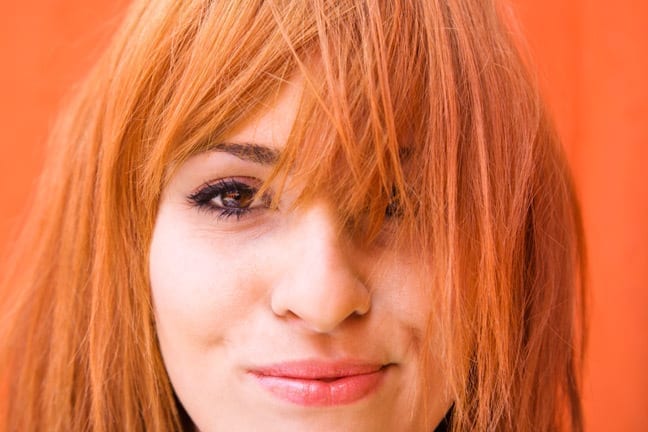
Those with warmer undertones in their skin will look better with a warmer hair color, like golden blondes or honey browns. Conversely, those with cooler undertones in their skin will look better with cooler hair colors, like ash blonde, black or auburn brown.
“Generally the makeup you are using should already tell you if you are a warm- or cool-toned person,” said Mark Garrison, owner and celebrity stylist at Mark Garrison Salon in New York. “But if you are unsure, look at a vein in your arm under natural light. If it appears green, then you have warm tones, if it is blue then you have cool-toned skin.”
A good colorist will study the overall skin tone, color of the eyes and age, according to Garrison. “The skin tone tells you what tone the hair should be.”
READ MORE: 7 Tricks to Make Your Highlights Last Twice as Long
Eye Color and Hair Color
“The color of the eyes is another indicator,” says Garrison. If your eyes are deep brown, black-brown, gray blue, dark blue or hazel with white, gray or blue flecks you look best with cool tones in your hair. However, if your eyes are golden brown, green, turquoise or hazel with gold or brown flecks you will look best with warm tones in your hair.
Age and Hair Color
“The age of the client lets you know how far from the natural-born hair color you should go because softer colors look better as we age,” said Garrison. “Yet, extremes (platinum blonde or black hair color) tend to bring out the imperfections and wrinkles in the skin, so save those for your younger years.
”Be aware that your skintone changes as you age. “Right before you turn gray, the hair gets a little darker,” said Van Gogh. “Your skin is preparing to lose pigment as you age. Then, when your hair turns gray, your skintone gets lighter.”
What’s growing out of your head naturally today may be different than what you had when you were a teenager, so just remember to stay within two levels of lightness or darkness of your current natural color. “That prevents mistakes from happening,” added Van Gogh, “and keeps you looking the most natural.”
But if you want something bold, you can always make extreme color changes more smoothly if you keep within the correct warm or cool tones, according to Garrison. “And if you don’t care if your hair color looks natural, have fun with it!”