
















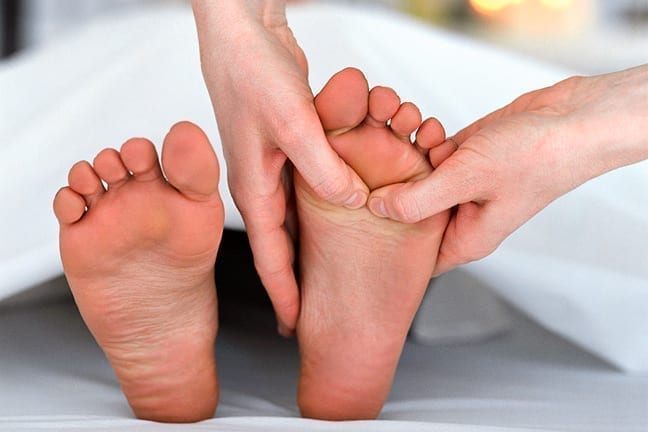
The Basics: With more than 7,000 nerve endings in each foot, it’s no surprise that a simple touch can trigger pain, a tickle or a relief of tension. These nerves connect with points all over the body through the spinal cord and brain.According to reflexology, the body’s symptoms indicate internal energy blockages, which can be released by stimulating corresponding areas on the feet and hands. Reflexology works on specific points of the feet and hands that correspond to each part and organ of the body. Have a headache? Press points over the entire thumb, for example, and you may feel your headache dissipate.“Reflexology relieves the stress and tension from organs, allowing them to relax, receive better blood and nerve supply, and normalize,” says David Cook, a New York City-based reflexologist and reflexology teacher certified by the International Institute of Reflexology and the American Reflexology Certification Board. “A reflexology treatment may help you in unexpected ways, including lifting your spirits.”But don’t call reflexology a mere foot massage. After an average 45-minute session, a client’s feet often feel revived and renewed, but the experience can be a mix of pleasure and pain. According to Cook, reflexology points that correspond to areas of constriction and blockage in the body may feel tender to the touch, so a reflexology session is likely to bring up areas of soreness. Reflexology is also a convenient self-care practice, ideal for taming daily tension and pain and bringing on stress relief, according to Cook.Scientific Support: The effects of reflexology are largely unproven, though several studies demonstrate its potential as a healing therapy. A 1999 study of headache and migraine suffers in Denmark—where reflexology is a top alternative treatment—showed that, at the three-month follow up mark of the study, 81 percent of participants reported that reflexology treatments helped or cured their headache symptoms.Complement to Western Medicine: Reflexology is not a substitute for medical treatment, but it can complement other therapies. Reflexology is not known to interact with other treatments and can significantly change a patient’s quality of life by helping to manage pain and encourage healing.“Reflexology has a tremendous cumulative effect,” says Cook, who recommends two to three weekly sessions to treat a health condition. In some cases, the alternative medicine treatment can be used to ease more serious conditions not helped by Western medicine, according to Cook. For example, a patient with a ruptured spinal disc who can’t undergo surgery could receive reflexology to relax the area around the rupture and promote healing. You can find a certified reflexologist through the American Reflexology Certification Board.What it’s Best For: Reflexology is an effective therapy for relieving musculoskeletal aches and pains, including back, shoulder and hip aches, and spinal problems. The treatment also helps clear up allergies and ease headache symptoms.The Beauty Connection: The top of the big toe is the key reflexology point that’s linked to the face; stimulating this point can increase circulation and improve skin tone over time, according to Cook. But reflexology also helps you look and feel beautiful by keeping our bodies free of pain and tension. “When you’re getting regular reflexology, you’re in good health, and if you’re in good health, you have a glow about you,” says Cook. “Just having your body in balance improves your beauty, your skin and your hair growth.” Some forms of reflexology also use facial stimulus points to treat the body, which has the added benefit of relaxing facial tension and increasing circulation.
LATEST