
































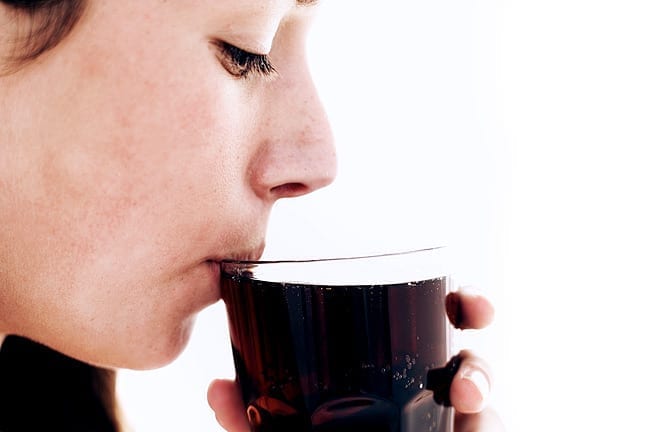
Do you love drinking an afternoon soda, or put sugar in your morning coffee? Policy-makers want you to stop.New York City is currently running an advertising campaign featuring a man drinking a glass of fat, and a soda bottle overflowing with liquid fat. It’s part of an aggressive effort—happening across the country—to reduce people’s consumption of sugar-sweetened beverages (SSBs).Americans guzzle an average of 50 gallons of sugar-sweetened beverages—including sodas, fruit juices with added sugar, sports and energy drinks, flavored waters and sweetened milk, tea or coffee—per person every year.That’s not doing our figures any favors.Researchers blame SSBs, at least in part, for the ballooning obesity crisis, as well as higher rates of diabetes, heart disease, high blood pressure and cancer. Not to mention that soft drink lovers are less likely to get the calcium and other nutrients they need to keep their bodies healthy.MORE: Expert Tips For a Sugar-Free DietHow are policy makers hoping to lower consumption? By imposing a soda tax—a tax per ounce on sugar-sweetened beverages, and possibly diet drinks too. Here, we look to the research to figure out if a soda tax stands a chance.BACKGROUNDIn 1994, Kelly Brownell, Ph.D., Director for the Rudd Center for Food Policy and Obesity at Yale University, first proposed taxing sugary drinks. Since then, more than 30 states have imposed small taxes on sugar-sweetened drinks, and some states—like Maine and New York—have been fighting to increase them.Even a very small soda tax could raise big bucks for your city. In New York City, a five-cent tax on sugar-sweetened and diet beverages would generate almost 30 million dollars in 2011 alone—an amount that could help offset obesity-related healthcare costs. (Currently, soda tax funds are not used for this purpose.)MORE: Calculate How Much Your City Could Earn From Soda TaxesBut the real question remains: Could a soda tax make a dent in the rising obesity rate?THE DEBATESIDE 1: Yes, a soda tax will fight obesity!Those who support the soda tax believe it would discourage people from downing sugary drinks and quell the rising tide of obesity.Several studies suggest they’re right.A 2010 study in the Archives of Internal Medicine followed 5,000 young adults over a period of 20 years and found that those who purchased a soda costing one dollar more ate 124 fewer calories that day. They concluded that an 18 percent increase in the price of soda could amount to a five-pound weight loss per person. Across the whole country, that could be substantial.”Sugared beverages exact a toll on the nation’s health and much like tobacco taxes have had a very positive impact, soda taxes could make a real difference for both adults and children,” says Brownell.
A soda tax may even be more effective than subsidies on health food.Researchers at the University of Buffalo found that a 10 percent tax on junk food—including sugary drinks—encourages women to purchase healthier, lower calorie foods at the grocery store, and is more effective than lowering the cost of health foods. In fact, cheaper health food actually encouraged women to “treat” themselves to junk food, leaving more calories and fewer nutrients in their virtual shopping carts.The most widely cited case for a soda tax is a 2009 article in the New England Journal of Medicine, written by Brownell and Thomas Frieden, director of the Centers for Disease Control and Prevention. They argue that the impact of a soda tax depends on how it is implemented, noting, “only heftier taxes will significantly reduce consumption.”MORE: How Sugar Sneaks Into Your DietSIDE 2: No way, it’ll barely make a difference.The nay-saying experts think a soda tax is unlikely to change behavior and won’t lead to noticeable weight loss.Eric Finkelstein, associate research professor of economics at Duke University, does agree that a tax would help reduce consumption, but he doesn’t think that’ll lead to weight loss. “The problem is that any savings in calories is partly offset by switching to other beverages and to some extent, other foods. So this alone would have almost no effect on obesity.”Some studies so far have supported that concern, including a 2010 study from Yale University, which found that soda taxes do impact BMI, but the effect is very small—much smaller than it would need to be to really combat obesity.
But all of that might be beside the point.A 2011 study from Northwestern University, led by economics graduate student Ketan Patel, found that a tax on sugary drinks would miss the target: Obese people are much more likely to drink dietsoda. Not only that, but Patel found that obese people, regardless of socioeconomic status, are less price sensitive, meaning that a tax is unlikely to dissuade them from choosing the drinks they love.MORE: Should There Be a Diet Soda Tax?What’s more, tax or not, soda may still remain the cheapest beverage option. “Even with a large tax, soda is still cheaper than healthier drinks, so that is why [a soda tax] may be least likely to change behavior,” says Finkelstein. He’d rather see a tax on junk foods across the board, including French fries, potato chips, and other treats that are known to pad a paunch.THE MIDDLE GROUNDBrownell, who initially proposed the soda tax, continues to support it. However, he says that the taxes are currently “too small to affect consumption” and suggests that future revenues be earmarked for obesity-related health programs.On that point, most experts seem to agree.Dr. Michael Roizen, chief wellness officer at the Cleveland Clinic and co-founder of YouBeauty, thinks a soda tax could work, but only if it was much bigger. “At five cents a bottle the tax is a nuisance but will not stop people from drinking soda.” He points to the cigarette tax as a prime example: “It didn’t become hurtful until they were taxed four dollars a pack! With sugared soda, the tax needs to be a more than a quarter per bottle to make a difference.”Patel also agrees that the bigger the tax, the more it prohibits consumption. And while Finkelstein doesn’t think a soda tax could be effective on its own, he does support it as part of a larger effort. “When it comes to obesity, there is no silver bullet,” he says. “Potentially, lots of bullets could be combined to make a difference.”To really see success, Finkelstein recommends targeting kids and schools. “That is the best chance to see success,” he says. (For each can or glass of sugary drinks per day, a child’s obesity risk goes up by 60 percent.) Patel agrees that targeting kids has the potential to make a difference, but he reminds us, “The benefit wouldn’t be realized for a really long time. It’ll take decades to work its way through.” Do we have the patience to wait?QUIZ: Do You Eat Pretty?