

































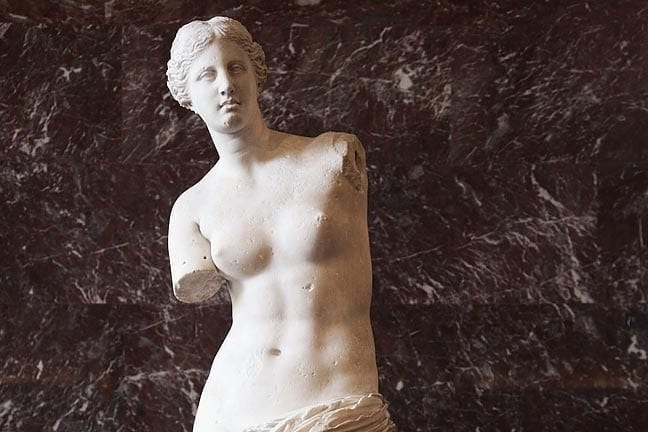
In my last couple of columns, I suggested that beauty matters: not only do we associate all kinds of positive qualities with attractive people, we even treat them better than we do less attractive people.But just saying that doesn’t do much to answer the question of what actually makes a person attractive.In other words, what are the qualities that make a person physically attractive? To answer this question we need to go back in time.In the sixth century B.C, the philosophers of ancient Greece began to search for a single law that would define the world as an ordered whole. One school of thought, led by Pythagoras, believed that everything—cosmology, the natural sciences, philosophy, even beauty— was simply a matter of proportion. Asked “what is wisest?” Pythagoras and his school are said to have replied, “Number.”For the Pythagoreans, there was a simple mathematical order behind the confusion of the observable world. More than this, they believed that the key to understanding what made something or someone beautiful was likewise a matter of mathematical proportion. It’s not surprising then that Pythagoras and his followers are sometimes said to be the first proponents of an objective view of beauty. According to this view, if we want to understand what makes a building, a piece of music, even a particular face beautiful, we have to start with its mathematical proportions.Here’s a very simple example: the Parthenon in Greece is often said to be magnificent building, but what exactly makes it beautiful? Well, some studies suggest that its proportions approximate what’s known as the “golden ratio.” The Parthenon’s façade, the intervals between its columns, and elements of its interior are all said to have been designed according to this ideal mathematical ratio. So, what makes the Parthenon beautiful? The fact that it incorporates the right proportions in its architectural design.MORE: Why is Beauty Valued?And here’s the point of this history lesson: those who agree with Pythagoras sometimes argue that what makes a person attractive is, you guessed it, the fact that they have the right mathematical “proportions.” How we define those proportions may vary (and in my next column I’ll discuss some recent suggestions), but the basic claim is that it should be possible to define beauty in pure, mathematical terms.But that’s not the end of our time traveling. Although this objective view of beauty was widely accepted, a decisive shift in how we understand beauty took place in the eighteenth century with the birth of a subjective view of beauty. Rather than defining beauty in terms of mathematical formulae, some philosophers began to argue that beauty was, in fact, marked by our individual responses, feelings and emotions. Perhaps the most famous statement in support of this view was made by the Scottish philosopher David Hume:“Beauty,” he said, “is not quality in things themselves; it exists merely in the mind which contemplates them; and each mind perceives a different beauty. One person may even perceive deformity, where another is sensible to beauty; and every individual ought to acquiesce in his own sentiment, without pretending to regulate those of others.”This idea was later popularized in Margaret Wolfe Hungerford’s novel “Molly Bawn,” where we find the famous line, “Beauty is altogether in the eyes of the beholder.” This subjective view of beauty seems very appealing:rather than worrying about golden ratios, mathematical formulae, or proportions, we need to be thinking about individual preferences. In short, each of us might have very different views of what makes someone attractive or not-so attractive.QUIZ: Is Your Face Symmetrical?So, which of the two views is correct? Are there objective criteria that determine whether or not someone will be perceived as attractive? Or is it pointless to think in terms of objective criteria precisely because “beauty is in the eyes of the beholder”? I won’t spoil the fun by telling you what I think just yet, but in the coming weeks, I’ll present both sides of the argument in more detail and let you make up your own minds.But before I go, let me leave you with one last story. The Venus de Milo is often said to be one of the finest sculptures of the female form and poets, artists and philosophers have all been quick to praise the sculpture as having the right mathematical ratios. Recently, for example, some psychologists have claimed that she has the right waist-to-hip ratio, which gives her the “perfect” hourglass figure. Others have claimed that her facial features show signs of the “golden ratio,” which again adds to her beauty.But not everyone agrees. Toward the end of the 19th century, a German anatomist by the name of Wilhelme Henke began measuring the Venus de Milo in minute detail, only to find that many of her proportions were asymmetrical. Her legs are of different lengths, her eyes are not parallel to each other, nor are her lips, and neither her eyes nor her lips are perpendicular to her nose. Perhaps the Venus de Milo is not perfectly-formed after all.The story of Wilhelme Henke and the Venus de Milo is illuminating for two reasons. First, Henke would not have known it at the time, but his work set the tone for many hundreds of psychological studies that have attempted to measure physical attractiveness. The technology might have improved since the 19th century, but the basic method has remained the same. And second, his work highlights the difficulty of drawing firm conclusions when it comes to the debate about objective or subjective views of beauty.MORE: The Smell of Attraction
LATEST