
































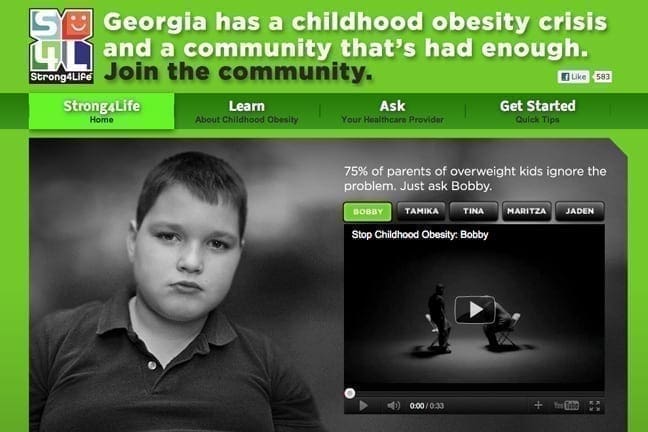
In addition to being known for peaches and pecans, Georgia has the unique distinction of having the second highest rate of childhood obesity. To slim down that statistic, Georgia Children’s Health Alliance launched the $50 million Strong4Life campaign, which includes suggestions for eating well and staying active, as well as some controversial commercials and print ads to raise awareness.In one ad, there’s a black and white photo of a sad-looking girl with copy that reads: “It’s hard to be a little girl if you’re not.”In another video, a tween boy asks, “Mom, why am I fat?” And another ad with a solemn teen reads, “My fat may be funny to you, but it’s killing me.”Like the Strong4Life tagline says, they want to “stop sugar-coating the problem” of childhood obesity. But for many parents, nutritionists and psychologists, their strategy of singling out kids has been tough to swallow.Social worker Heather Quinlan, who specializes in counseling children and teenagers, points out that shaming and mocking aren’t effective motivators. “If [ridicule] was enough to make people lose weight and be healthy, there would be a lot fewer people overweight at every age in this country,” says Quinlan.WATCH VIDEO:COLUMN: Banning Chocolate Milk from Children’s LunchesYouBeauty Psychology Advisor and the author of “Smart Thinking” Art Markman doubts the campaign will be effective in achieving its goals based on the similarities in approach it shares with unsuccessful anti-smoking campaigns. From a purely marketing perspective, “We know that fear campaigns don’t work.” He also argues that obesity awareness, or pointing out people who are fat, seems redundant to anyone with a mirror.But how can you reach out and talk to kids about the highly touchy subject of their weight? While the state of Georgia’s approach is debatable, the problem is something we struggle with nationwide. Currently, the CDC estimates that 17 percent of kids ages two through nineteen are obese. That’s triple the rate just a generation ago. Yikes!Clearly, it’s important to start a dialogue about weight with our kids. So we asked the experts to weigh in— no pun intended— on six simple, supportive and age-appropriate steps to broach the topic and ensure that our children get and stay healthy.Focus on HealthHow many times have you told your child, “it’s what’s inside that counts”? Well, when it comes to wellness and nutrition, that couldn’t be more true.The first step is to stop thinking of weight issues as mainly an appearance problem. In fact, “The best approach is not talking specifically about the weight itself,” explains YouBeauty Nutrition Advisor Kristin Kirkpatrick, R.D. She suggests that when you talk to your child, don’t talk about dieting or fat, but rather a desire to be healthy.Quinlan, who has counseled many teens with eating disorders, couldn’t agree more. An emphasis on looks, like the Strong4Life campaign, is dangerous because, “it almost serves to define people based on their weight and that is the last thing that we want in terms of people having healthy body images and healthy perspectives on themselves,” she notes.Health is something we can all get behind without chipping away at our body confidence.It’s A Family AffairKirkpatrick insist that to achieve a healthy lifestyle you have to include your whole family, not just pick on a troubled member or two. After all, healthy eating is in everyone’s best interest. “Even if mom and dad or the other siblings aren’t overweight, it still needs to become a family affair,” Kirkpatrick says. “It can’t be something like, ‘Okay, you’re going to go on a diet!’ That doesn’t work with kids.”And Kirkpatrick knows first hand how to talk to children because she herself struggled with weight as a kid. With the help of a dietician, she and her family turned things around together. She suggests you start by including your children in meal planning, grocery shopping and cooking so they feel empowered and involved in their own healthy lifestyle. Be sure to include plenty of vegetables and fruits—cherry-flavored soda doesn’t count.MORE: Sneak in Health-Boosting VegetablesYou also want to be sure to skip foods that are processed. Kirkpatrick is quick to point out that the timing of the rise in obesity coincides with the rise of convenience foods. “Our parents may have been making meals from scratch, but now people can just put things in the microwave or the oven—highly processed foods, refined grains, lots of fat, lots of calories,” she says. Don’t fall into the fast food trap and go for whole foods—fruits, vegetables, lean protein and complex carbohydrates—instead.Get Out And PlayAdults might call it “exercise,” but with kids, you can call it something much more fun: “play time.” Avoid words like “workout” that make fun activities seem like a chore.Psychologist Sofia Rydin-Gray, the assistant director of behavioral health and lifestyle coaching at Duke Diet and Fitness Center, recommends letting your child chose which sport or activity they want to participate in. Whether it’s soccer, bike riding or ice-skating, the benefit of prioritizing physical activity does more than just burn calories. “You realize that there are more things to your body than the weight and what it looks like,” says Rydin-Gray.And that kind of focus on personal strength and achievement also builds confidence and self-esteem in your child. Extra points if you can find activities you like to do together as a family such a canoeing, hiking or even lapping the neighborhood with the dog.QUIZ: How’s Your Self-Esteem?Force Of HabitWhen your kids grab a junk food snack from the kitchen, you don’t want to have to tell them “no” and point out it’s because you’re already concerned about their weight. Ouch!It’s better to not have those foods on hand by clearing your cabinets of cookies, candy and chips. As Markman reasons, “If you keep, high fat, high sugar, high sweet foods in your house, you’re going to eat them. No matter what your best intentions are.”And who wants to fight that temptation constantly? “You don’t want to have to think about how to eat every single day,” says Markman. “You’d spend all your time worrying about eating! What you want to be able to do is eat healthfully, mindlessly.”That takes changing what’s available around the house. Fill your fridge with only fresh, nutritious and delicious options for your kid and the rest of the family.“If you have a kitchen full of a lot of healthy choices, then you’re still letting kids exercise their own sort of freedom and take things they like best,” adds Quinlan. “So there’s a lot that you can build into your family pattern and habits growing up that gives them a good start. And then it becomes routine.”Talk the Talk, Walk the WalkJust as parents have to set an example by watching what goes into their mouths, they also have to pay attention to what comes out—and that means absolutely no fat talk. Even if you’re serving healthy meals, your children might develop bad eating habits and a negative self-image if you’re smack talking your own body.Psychologist Rydin-Gray argues, “I can sit here all day and talk about what my concerns are about this [Strong4Life] campaign. Then, if I go home and I tell my kids, ‘Oh I hate that I gained five pounds over the holidays, I’ve got to lose weight,’ they’re seeing what I do, not what I tell them.”MORE: Being a Good Role Model for Your ChildrenSet the example by respecting yourself, your body and your family. After all, they are the people who most strongly resemble you. If you don’t think that you’re a total babe, where does that leave them?Think For YourselfTurn the negative messages in the media into a positive by encouraging an open dialogue with your children. “I think that there’s a lot to be said for being honest with kids in an age-appropriate way,” Quinlan notes. So, don’t be shy, start the conversation.If you live in Georgia, ask your children how the Strong4Life ads make them feel about their bodies. Or in the rest of the country, you can start a discussion around unrealistically thin supermodels and how that affects them. Be sure to listen to what your kids have to say and feel free to share your own opinion with them.Rydin-Gray says suggests this kind of discussion is the perfect opportunity to help your children really think about the messages they’re receiving and to hone their own values. “Teach the kids the importance of being critical of the media,” she says. “We’re not to believe every single thing that we see in an ad campaign or on the computer or in the news.”And that’s especially true when they’re suggesting we have to look a certain way or weigh a certain amount, rather then focusing on being healthy and happy.MORE: Program Brings Healthy Dining to Kids
Six Ways to Help Your Child Reach a Healthy Weight
LATEST